Y Hacks - 1st Place Hardware at Yale Hackathon
timeline: 2026
tech stack: Python, Arduino, LiDAR, OpenCV, IBT-2, 3D Printing
Overview
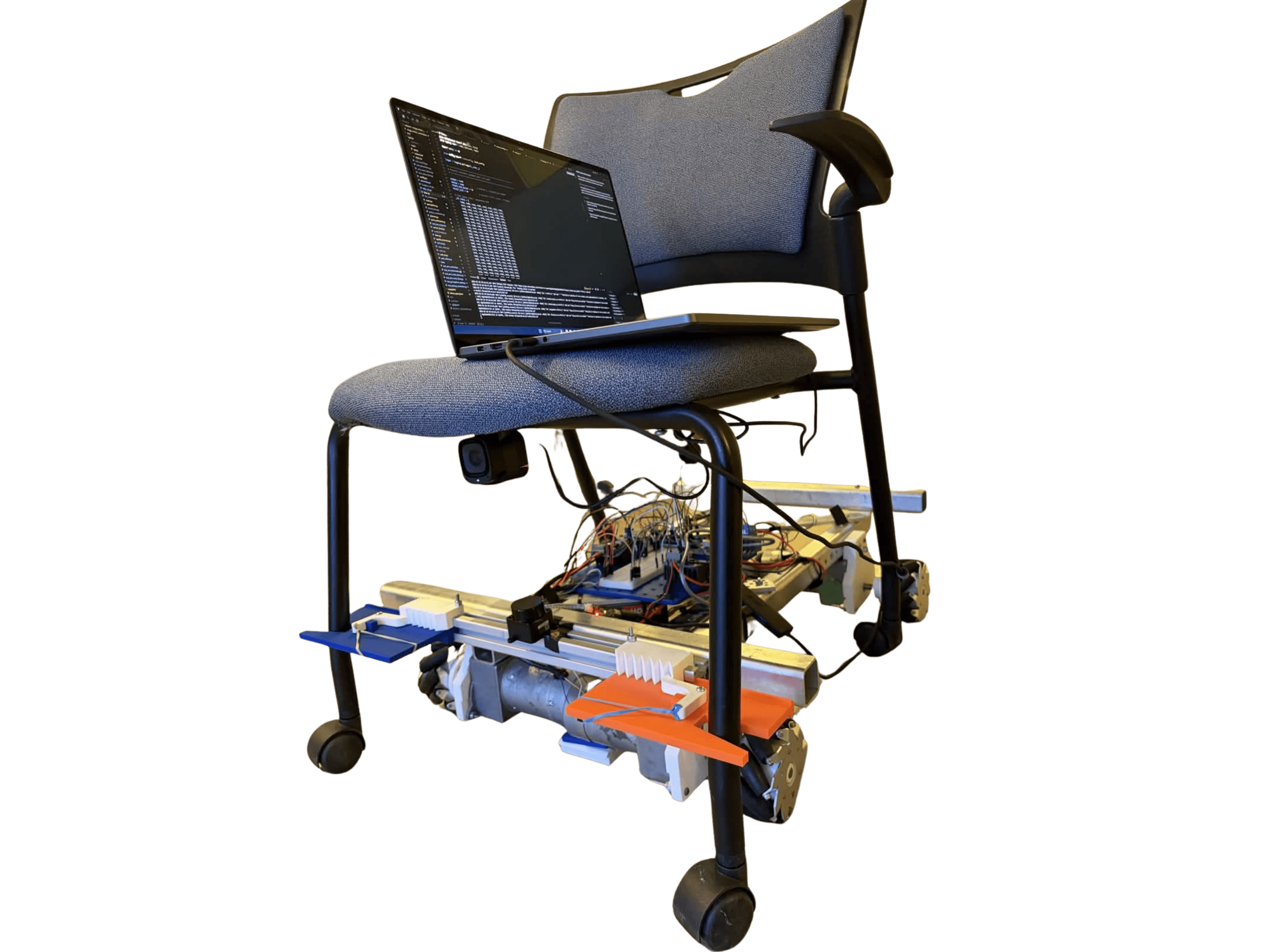
An autonomous wheelchair attachment built in 24 hours at Y Hacks, Yale's annual hackathon. It bolts onto any existing chair using 3D printed ratchet mechanisms, no tools or permanent modifications needed. Mecanum wheels give it omnidirectional movement, and a 2D LiDAR plus webcam handle basic obstacle avoidance and point-to-point autonomy.
How It Works
The attachment uses 3D printed ratchet mechanisms to clamp onto any standard wheelchair frame in seconds. Mecanum wheels replace the standard drive wheels, giving the system omnidirectional movement. A 2D LiDAR handles spatial mapping and obstacle detection, a webcam adds visual context and computer vision, and motor encoders close the loop on a PID motion controller for precise positioning. A laptop runs the navigation stack, sending commands down to an Arduino which drives four BDC motors through IBT-2 motor drivers.
Architecture
Results
Awarded 1st place in the hardware category at Y Hacks and the VIAM side track, totalling $2,000 in prize money.